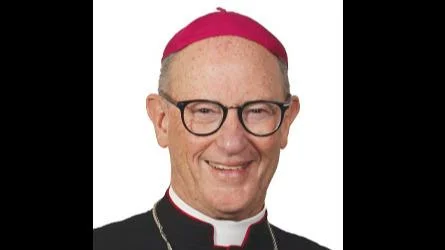
Rev. James D. Conley, D.D., S.T.L. | Diocese of Lincoln website
A recent Q&A session addressed common questions about the role of permanent deacons in the Catholic Church, with responses provided by Deacon Matthew Hecker. The discussion covered topics such as the process of becoming a deacon, differences between deacons and priests, sacramental roles, marriage and celibacy rules, age requirements for ordination, distinctions from other church ministries, and how to learn more about the vocation.
Deacon Hecker explained that becoming a permanent deacon is not simply a personal choice but a response to a spiritual calling. "To be honest, no one really 'chooses' Holy Orders. Rather, we are called by the Holy Spirit to discern a vocation to Holy Orders. As a young man, I discerned that I was not being called to the priesthood. However, the Archdiocese of Denver, my home, was an early adopter of the permanent diaconate. It opened for me another possibility of how, in my love for God, I might serve his Church. In the succeeding 30+ years, the idea of the permanent diaconate was one I continued to keep in prayer. Bishop James Conley arrived in Lincoln, following his time as auxiliary bishop of the Archdiocese of Denver. He was open to the possibility of extending the permanent diaconate to the Diocese of Lincoln. From there, I began an extensive time of formation and discernment, leading eventually to ordination in 2021."
On why someone might choose to become a deacon rather than a priest, he stated: "The two are fundamentally different. Because men are ordained as transitional deacons on the path to priesthood, we tend to think of deacons as 'priests in training.' Priests are ordained as 'sacramental ministers,' meaning exactly what it sounds like. The Church needs them or else we have no access to the sacraments.
Deacons, on the other hand, are ordained as 'servant ministers.' We are called to bring the living presence of Christ the servant into a dark and broken world. Think of the parable of the lost sheep. Jesus leaves the 99 sheep in order to search for the one lost sheep. When he finds it, he rejoices and places it on his shoulders. That is a beautiful example of the servant heart of Christ. His action was not sacramental (one of the seven sacraments). Deacons are called into a very deep relationship with the servant heart of Christ, enough to surrender our own plans for our life in order to be available to serve the people of God."
Addressing whether deacons can perform baptisms and preside at weddings—both sacraments—he clarified: "Yes, they are. Bishops, priests, and deacons are the 'ordinary ministers' of baptism. However, in case of necessity, any baptized person can validly baptize provided they have the right intention and use the correct Trinitarian formula. Thus administering the sacrament of baptism is not limited to Holy Orders. In a marriage ceremony, bride and groom are primary ministers because they exchange vows and give consent; priests or deacons preside over ceremonies as official witnesses for Church marriages."
Regarding marriage and celibacy rules for permanent deacons: "Yes under limited circumstances permanent deacons can be married—that is if married at ordination they’re dispensed from celibacy; if unmarried at ordination or widowed after ordination they must remain celibate."
He also noted minimum age requirements: canon law sets 25 if unmarried or 35 if married; U.S bishops require all candidates be at least 35 years old; most dioceses set an upper limit around age 60 due largely to health considerations.
Explaining differences between being a deacon versus an acolyte or lector he said: "Good question...the Church previously had minor orders...Following Vatican II only acolytes/lectors remained as ministries...While serving on altar is important feature it’s just one part expected from deacons." He added that during ordination rites candidates pledge obedience directly before their bishop.
For those interested in learning more about becoming a permanent deacon he advised speaking first with one's pastor then reaching out directly: "Begin with speaking at length with your pastor...If you remain interested please contact me—I would be happy to visit with you..."

 Alerts Sign-up