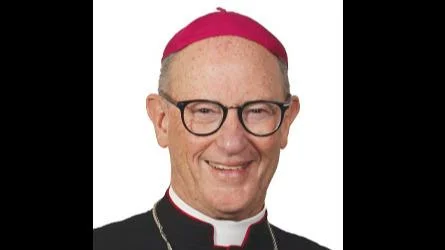
Rev. James D. Conley, D.D., S.T.L. | Diocese of Lincoln website
Two representatives from the Catholic Diocese of Lincoln recently provided training for new deacons in the Catholic Diocese of El Paso, Texas. The session, held over Zoom on November 22, was focused on effective communication and homiletics.
Deacon Matthew Hecker, director of the Permanent Diaconate Program in Lincoln, and Dennis Kellogg, director of communications for the diocese, led a two-hour training titled “Delivering a convincing message.” The session was part of a series for 18 new deacons ordained in January in El Paso. The training also included participation from the deacons’ wives.
During the session, Deacon Hecker spoke about the importance of prayer in preparing homilies. “Preaching always begins with prayer,” Deacon Hecker said. “The homily is not my message to God’s people. It is God’s message to his people. I’m simply the messenger, but I can only receive the message in prayer and contemplation.”
Hecker, who is also the first ordained permanent deacon in Lincoln’s diocese, described the role of deacons as representing Christ’s servant heart to their communities. “Deacons are called to powerfully conform their very lives to the humble, servant heart of Christ, ‘who humbled himself to enter into our humanity.’”
He also highlighted that most permanent deacons do not have as much formal theological or scriptural training as priests and therefore must rely on a strong personal relationship with Jesus Christ when preaching. “Thus, our preaching has to come from the heart of a deep relationship with Jesus Christ, formed by years of frequent prayer, spiritual reading, daily Mass and walking this journey with Christ,” he said.
As part of an exercise during training, participants developed homilies relevant to their local community. Several cited current challenges such as immigration issues along the southern border and emphasized respect for migrants’ human dignity.
Kellogg’s portion focused on basic communication principles. He explained how distractions—whether technical or mental—can interfere with delivering messages during Mass: “That model also includes ‘noise’ that can interrupt the ability of the one giving the homily to communicate God’s message to those in the pews,” Kellogg said. “That noise can be audible distractions...or it can be mental distractions...The goal is to overcome those obstacles and get the message to those who need it, which is all of us.”
Kellogg drew examples from scripture highlighting Jesus’ teaching methods: “Jesus also used stories to communicate his message, but they were always stories with a purpose that led the listener back to his main message,” he said.
The invitation for this session came from Deacon Jesus Cardenas of El Paso. Cardenas leads El Paso’s diaconate program and had previously worked with Kellogg through a three-year cohort at Notre Dame’s McGrath Institute for Church Life under its Compelling Preaching Initiative.
“The McGrath Institute program led to the creation of our own program, ‘Prepare & Proclaim: Enriching our Mass Experience,’” Kellogg said. “One of the goals has been to emphasize good homilies are the responsibility of both priests/deacons and parishioners...That’s something I wanted to share with the El Paso deacons as well.”
“Prepare & Proclaim” was developed after listening sessions across various groups within Lincoln Diocese and aims at improving Mass experiences through focused preaching and active participation by parishioners.
This session marked the sixth training this year for new deacons in El Paso; previous sessions addressed topics including foundational aspects of homiletics and practical application of scripture.

 Alerts Sign-up