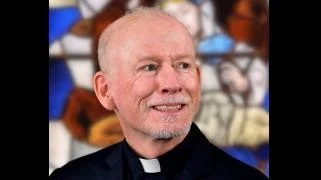
Rev. Brian J. Shanley, O.P. President | St. John's University website
Joseph M. Vukov, Ph.D., Associate Professor of Philosophy at Loyola University Chicago and Associate Director at The Hank Center for The Catholic Intellectual Heritage, delivered a lecture titled “The Catholic Intellectual Tradition in an Era of AI” on November 17 at St. John’s University’s Queens campus. This event was part of the 2025–26 Vincentian Chair of Social Justice Lecture Series, which is focused on the theme “The Catholic Intellectual Tradition.”
Dr. Vukov addressed the ethical, anthropological, and spiritual challenges posed by artificial intelligence (AI) from a Catholic perspective. He argued that the Church has historically embraced technological advancements rather than feared them.
He stated, “The Church encourages the advancement of science and technology and views them as part of the collaboration of man and woman with God in perfecting the visible creation.”
Referencing Pope Leo XIV’s choice to honor Pope Leo XIII—who led the Church during the Industrial Revolution—Dr. Vukov said, “He has leaned into AI.” He further emphasized that Catholics have traditionally welcomed technology: “The Church has explicitly endorsed, recommended, and even led the way in technological development.”
Dr. Vukov explained that many concerns about AI stem from misunderstandings about its nature. According to him, “Artificial intelligence is, above all else, a tool. The use of our tools, however, is not necessarily always directed solely to the good. In fact, when our ancestors sharpened flint stones to make knives, they used them both to cut hides for clothing and to kill each other.”
He also clarified that AI does not possess true intelligence but instead operates predictively based on human data and biases: “There’s all sorts of things that turn out to be absolutely central to human intelligence that AI, either obviously or not so obviously, just doesn’t do,” he said.
“Human intelligence includes embodiment, relationality, and an orientation toward the truth. Human intelligence wants to get things right, and wants to line up with reality and a capacity for willing, choosing, and desiring. Those are all things human intelligence does that a predictive tool simply isn’t doing. Do the limitations of AI mean that it’s a tool that we simply can’t use? Is the fact that it’s prone to bias and misinformation, and the fact that it doesn’t exactly replicate human intelligence, give us reasons not to use it? I don’t think so.”
In his remarks on higher education settings already using digital tools extensively—including those powered by AI—Dr. Vukov suggested some applications could be beneficial: “We’re already living in technologically rich classrooms. There are a lot of tools being pitched to us. I imagine the administrators in the room get pitched even more than the professors in the room new AI tools meant to enter the higher education space and make our lives better. I want to suggest that some of those might actually be correct pitches. There might be some applications in higher education spaces that do, in a substantive way, make our lives better.”
However, he cautioned against prioritizing efficiency or profit over human dignity as AI becomes more embedded in fields like medicine or business: “The problem comes in when our value alignment gets off, and when we pursue in such an efficiency to the detriment of more human-aligned values.” He added: “I think this idea of value alignment is a helpful way of thinking about where we’re going right and where we’re going wrong.”
Addressing social justice concerns related to access and distribution of AI technologies—a topic relevant given increased public access via free platforms—Dr. Vukov noted disparities remain: “The Church has had a lot to say about that over the years. In one sense, of course, it’s true that we all get to use these tools. ChatGPT is free. If you haven’t used it, you can pull it up on your phone right now and go for it. In a different sense, AI tools are inevitably distributed unequally, and in ways that often are unjust.”
Discussing preferential treatment for marginalized populations within Catholic teaching as applied to technological integration decisions he remarked: “We have moved forward with AI integration without really giving an option at all to the vulnerable let alone a preferential option,” Dr. Vukov said.
Miriam E. Prever—a doctoral student attending—commented: “Dr. Vukov’s lecture came at a crucial moment when artificial intelligence is at the forefront of everyone’s mind… I truly appreciated him taking time… especially as we navigate how AI is beginning to alter our very sense of what it means to be human.”
Dr. Vukov concluded by stating: "The Catholic intellectual tradition can help chart some contours… offer strategies… That is a gift… We need confront this era with both cultural & spiritual responses."
Rev Patrick J Griffin C.M., Executive Director Vincentian Center for Church & Society summarized: "Dr Vukov's lecture was tour de force... He proposed four basic questions around relationship artificial intelligence human dignity understood Catholic faith-based traditions... Drawing line from Pope Leo XIII Industrial Revolution Pope Leo XIV emerging digital revolution Dr Vukov offered foundation much further reflection discussion as seek just response today's world."


 Alerts Sign-up